Mini split smells musty in Round Rock, TX

Step 1 of 3: Equipment

Why does my mini split smell musty?

A musty smell from a mini split usually shows up when you first turn on cooling after it's been sitting, or it lingers every time the system runs. In a place like Round Rock, where the air stays muggy for months at a time, that smell is worth paying attention to. It's not your imagination and it's not just dust. Something inside the unit is growing somewhere it shouldn't, and the question is what and where.

The smell is mold or mildew growing on the evaporator coil or in the drain pan

A mini split pulls moisture out of the air every time it cools, and that moisture collects on the evaporator coil and drips into a drain pan before it runs out through a condensate line. If the coil stays wet between cycles, or the pan or line gets a film of buildup, mold starts growing right there in the air path. Every bit of air the unit blows past that spot picks up the smell and carries it into the room. Williamson County summers run long and humid, so the coil has a lot of moisture to deal with for months at a stretch, which gives mold more chances to take hold than it would somewhere drier.

A white wall-mounted mini-split indoor unit on a light gray interior wall, with a white curtain on a black rod at left and a leafy plant in the lower left corner.

Running clean

No smell when the air kicks on. The coil drains the way it should and the air coming out stays cool and plain. That's a mini split that's been cleaned on schedule, with the condensate line clear and the filter free of the buildup that gives mold something to grow on.

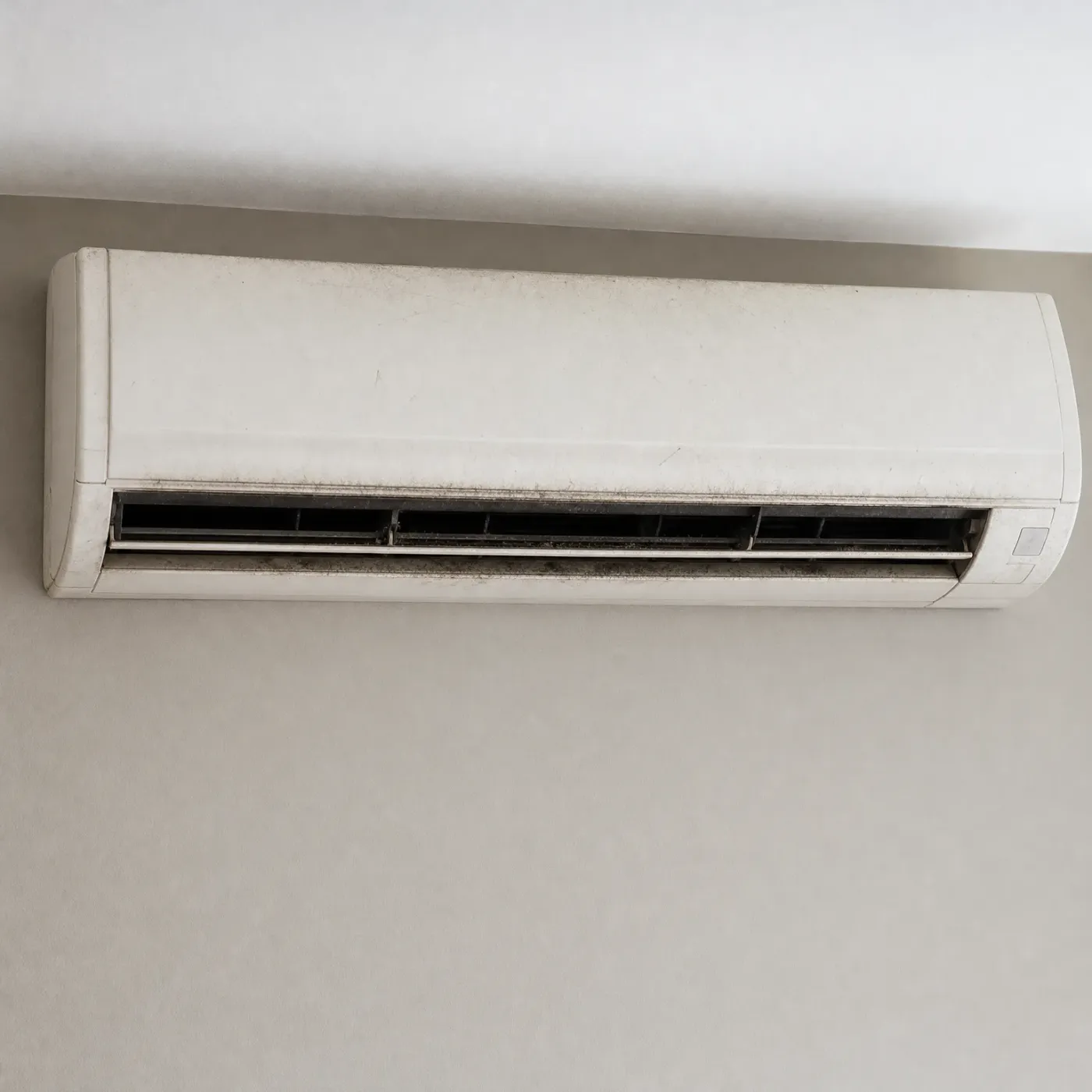
A wall-mounted white mini-split air conditioner indoor unit with visible dust and grime around its outlet vent, installed near the ceiling on a plain light-colored wall.

Musty and dirty

Dust and grime sit along the vents and casing edges, and that smell greets you every time the system starts. Mold has a foothold in the coil or the drain line, and it will keep producing that smell until someone cleans the unit out.

Is that smell a sign something's wrong with your mini split

Walk into the room and the smell hits before the air feels cool. Maybe it fades after a few minutes, or maybe it hangs around the whole time the unit runs. You might notice it more on the first humid morning after a stretch of mild days, or every single time you turn the system on through the muggy months. Sometimes there's a faint drip sound from the indoor unit, or a damp patch on the wall underneath it. Left alone, the moisture behind that smell gives mold a place to grow inside the unit, and a clogged condensate line can back up and leave water damage on the wall or floor below it.

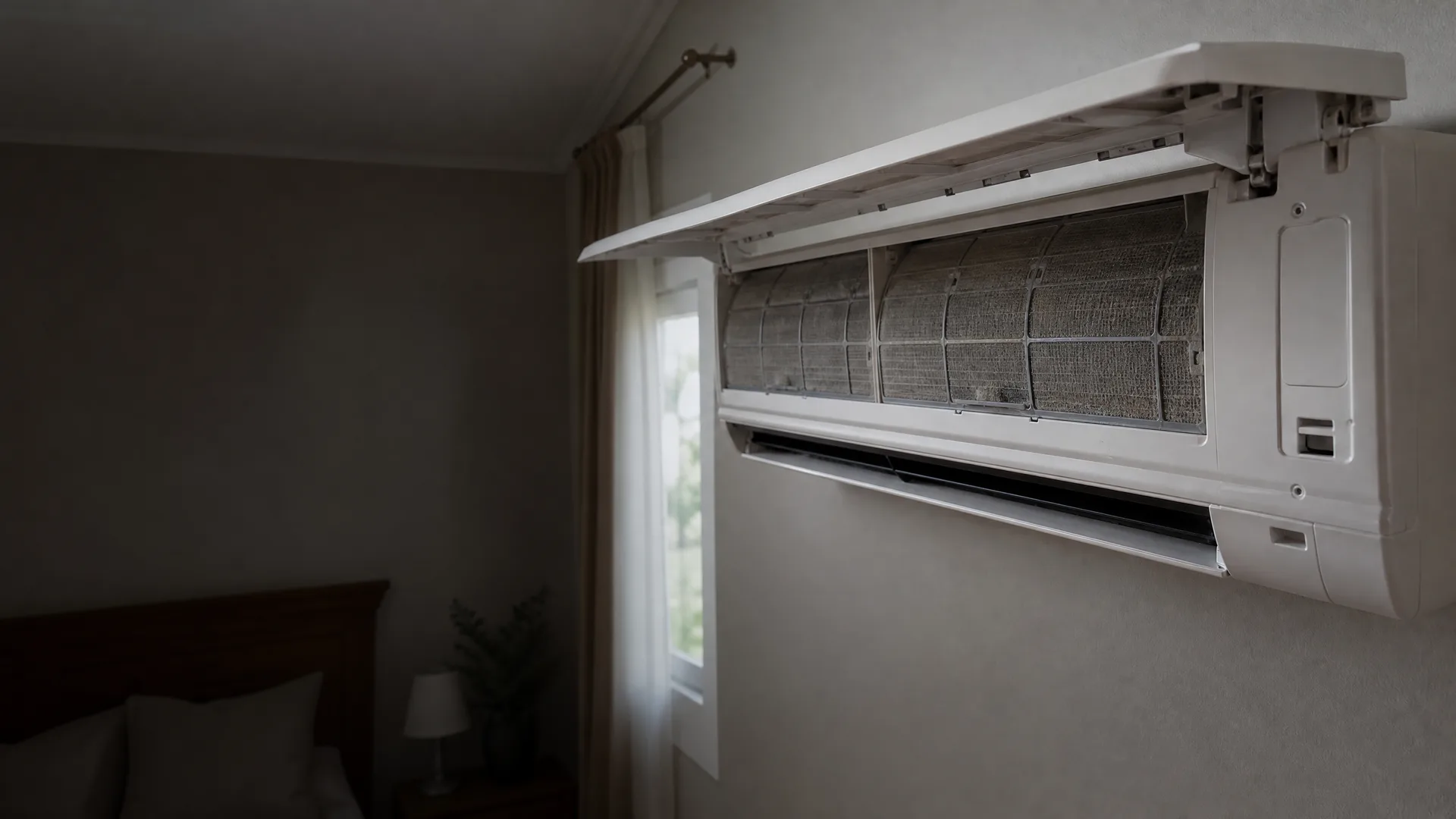
A wall-mounted mini-split air conditioner with its front cover open, exposing dusty filters and coil, in a dim bedroom with a window and bed headboard in the background.

Late afternoon, early spring, and you finally pull the cover off the indoor unit because the smell has been bothering you for a week. The filter screen slides out grey with dust, more than you expected. Outside the window the sky is still bright, that stretch in Williamson County when it hasn't turned muggy yet but you know it's coming. You hold the filter up to the light from the blinds and see how little air could have been getting through it. The room still smells faintly of the musty air the unit's been pushing out. You set the filter on the bed, meaning to rinse it, and look back at the open unit, at the coil behind it you can't quite see.


Why does a mini split in Round Rock grow that smell so easily?

  • Cooling runs April through October

    Cooling runs April through October, close to seven months straight, giving mold and mildew that much time to build up on a coil that rarely gets the chance to dry out.

  • Heat runs November through March

    Heat runs November through March, only about five months, which means the coil sits damp and unused for long stretches outside of summer, a setup mold is fine with.

  • Power here costs 13.97 cents per kilowatt-hour

    Power here costs 13.97 cents per kilowatt-hour, close to the national average, so there's no cost reason to run the fan less and let moisture sit on the coil.

NOAA nClimDiv 1991-2020 · EIA-861 2025

Why the coil stays wet

A mini split pulls moisture out of the air and that water has to leave the indoor unit through a condensate line, usually a thin tube running to the outside. When the coil is dirty, air moves across it slower and the water sits longer instead of draining right away. Dust and skin cells mixed with that standing water are what mold feeds on. It is not the refrigerant or the electronics causing the smell. It is a wet coil that takes too long to dry between cycles, which in a climate that stays muggy for months is most of the time the system runs at all.

What a clear line changes

A condensate line that drains freely empties the coil fully every time the unit cycles off, so there is less standing water for mold to grow in between runs. A clogged or sagging line lets water pool near the coil or inside the drain pan, and that pool does not dry out the way a clear line does. Checking the line means looking at where it exits the house, usually low on an outside wall, to see whether water drips out steadily when the system is running or barely drips at all. A line that is not draining is doing part of the work that produces the smell.

An older man with gray hair and a beard, wearing a dark coat dusted with snow, stands smiling in a doorway of a warmly lit home with a sofa, lamp and window visible behind him.
An older man with grey hair and a beard, wearing a dark coat dusted with snow, stands in a dimly lit entryway with a ceiling lamp, a side table with two shaded lamps, and a lit fireplace visible in a room beyond.
A bearded older man in a dark snow-dusted coat and scarf stands just inside a home's front door, with a lamp-lit room and snowy window visible behind him.
An older man with gray hair and a beard stands in a doorway of a home, wearing a dark coat dusted with snow, with a lit fireplace and lamp visible in the blurred room behind him.

Get the right pro for your mini split

That musty smell doesn't clear up on its own. A coil that's been sitting wet all summer keeps growing what's already there, and running the system more just pushes that smell through the room instead of drying it out. A mini split needs its coil and condensate line cleaned by someone who can get into the indoor unit properly, not just a filter rinse. With cooling running April through October here, a coil left dirty has months to get worse before winter gives it any break. Letting that sit through another stretch of muggy weather usually means the smell gets stronger, not weaker. Sending this request means you're done tracking down who handles mini splits around Round Rock and who has time this week. That part is off your plate now.

A white wall-mounted mini-split air conditioner installed high on a light beige interior wall below a white crown molding, with a wooden floating shelf holding a ceramic vase of green foliage at the lower left.

Left to grow all summer

A coil that stays wet from April through October doesn't dry out on its own between cycles. Mold and mildew build up on it the same way they would on any damp surface left alone for months. Each time the system runs, air passes over that coil and carries the smell into the room. The longer it goes without a cleaning, the thicker that growth gets, and the smell gets harder to miss, not easier.

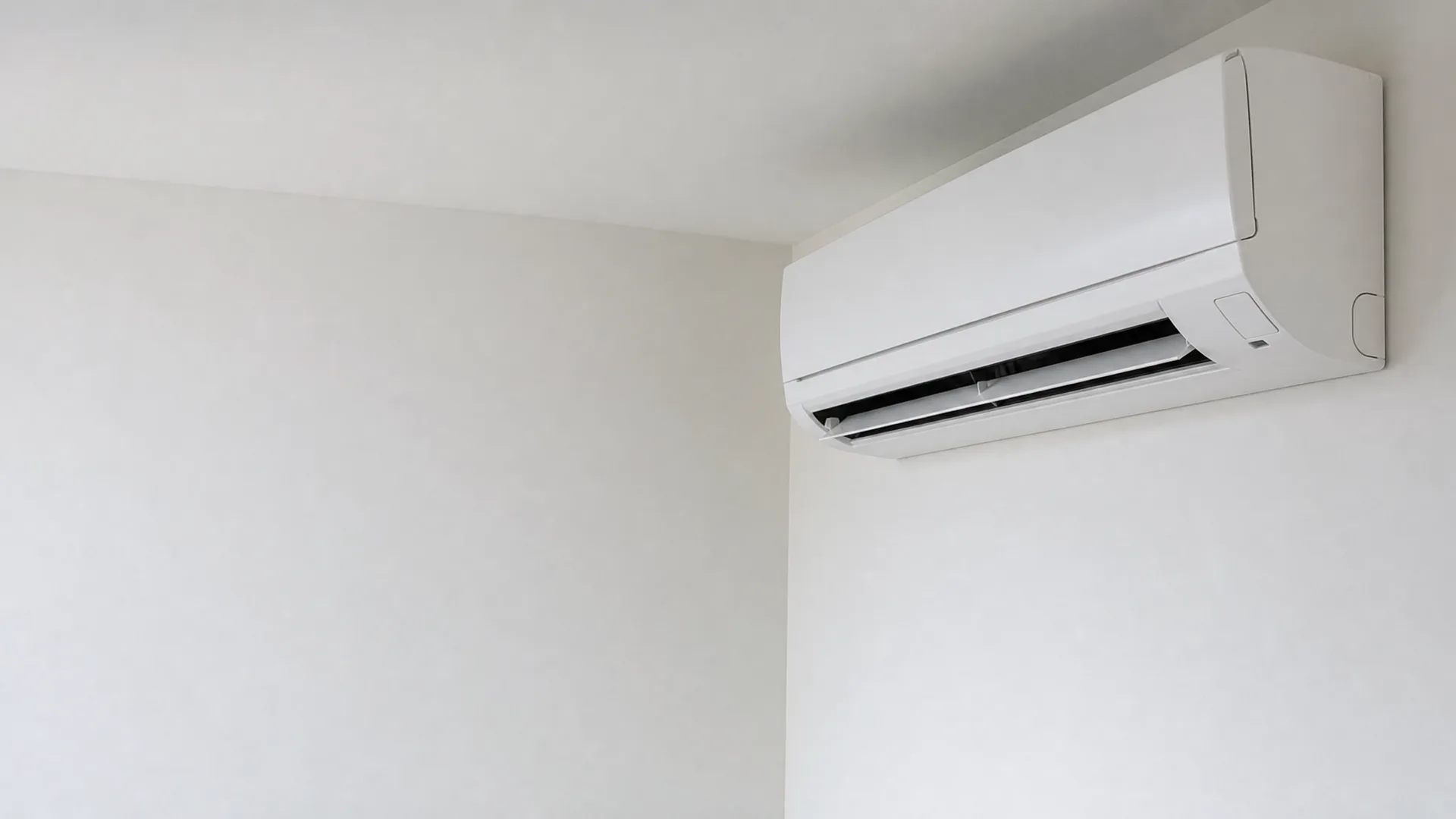
A white wall-mounted mini-split air conditioner installed near the ceiling in the corner of a plain white room.

Caught and cleaned early

A coil that gets cleaned before the smell sets in doesn't give mold the time it needs to take hold. The condensate line stays clear, water drains the way it's supposed to, and the coil dries between cycles instead of sitting wet. A mini split kept up this way can run the full stretch from spring through fall without that musty air showing up when the unit kicks on.

Cooling runs April through October

Seven months of cooling a year means seven months of that coil staying wet between cycles. Your mini split barely gets a dry stretch from April to October, so whatever's growing on the coil has all season to settle in before winter finally lets it dry out.

NOAA nClimDiv 1991-2020

What that musty smell comes down to

  • A musty smell means the coil or condensate line is wet and growing mold, not that the unit is failing outright.
  • Cleaning the coil and clearing the condensate line gives the smell nowhere to grow back from.
  • A filter clogged with dust slows airflow, and slower airflow means a wetter coil for longer.
  • Round Rock's seven months of cooling give mold that much uninterrupted time to settle into a dirty coil.
  • A unit kept on a regular cleaning schedule drains properly and the air stays plain when it kicks on.
  • Letting the smell run through another summer only lets it build on what's already there.

A musty smell from a mini split has one source: water sitting somewhere it shouldn't, usually on the coil or in the condensate line, with mold and mildew settled into it. That's the whole story. It doesn't mean the compressor is failing or the system needs replacing. It means moisture has had time to sit and something has started growing on it.

In Round Rock, that time is long. Cooling runs April through October, close to seven months, and every one of those months the coil is pulling moisture out of the air. A clean coil sheds that water fast and dries between cycles. A dirty one, or one slowed by a clogged filter, holds onto it longer, and mold doesn't need much time once the water's there to stay.

The fix is mechanical, not seasonal. Clearing the condensate line gives the water somewhere to go. Cleaning the coil takes away what the mold was growing on in the first place. Do both on a schedule and the smell has nothing left to come back from, no matter how long the summer runs.

Nothing about this gets better on its own. A mini split left alone through another summer just keeps adding to what's already on the coil, and the smell that comes with it. Caught early, with the coil and line cleaned before the buildup sets in, that's a problem that doesn't come back.

A woman wrapped in a thick cream knit blanket sits in an armchair beside a lit table lamp, with an open book in the foreground and a frost-covered window behind her.
A woman in a cream knit sweater sits in an armchair indoors, eyes closed and smiling, beside a window showing yellow and orange autumn foliage, with a mug on a wooden side table and shelves holding vases behind her.

A pro who works on mini splits

A musty mini split isn't something to live with until October. A contractor can clean the coil, clear the condensate line, and check the filter, so the smell has nothing left to grow on. Send the form and the search ends there. Someone who works on mini splits around Round Rock gets your details and reaches out, and from that point finding help isn't on your plate anymore. That's the whole job: a clean coil, a clear line, and air that just feels cool again.

Request a pro

One request and finding someone for the tune-up is handled.

It costs nothing to send, and you don't have to hire anyone.